
Lesson Objectives
- Give an overview of the phylum Arthropoda.
- Outline the characteristics and importance of insects.
Vocabulary
- arthropod
- invertebrate in the phylum Arthropoda, characterized by a segmented body, hard exoskeleton, and jointed appendages
- metamorphosis
- process in which a larva undergoes a major transformation to change into the adult form, which occurs in amphibians, arthropods, and other invertebrates
- molting
- process in which an animal sheds and replaces the outer covering of the body, such as the exoskeleton in arthropods
- pupa
- life cycle stage of many insects that occurs between the larval and adult stages and during which the insect is immobile, may be encased within a cocoon and changes into the adult form
- trilobite
- arthropod, which is now extinct and known only from numerous fossils
Introduction
Arthropods are not only the largest phylum of invertebrates. They are by far the largest phylum of the animal kingdom. Some 80 percent of all species living on Earth today are arthropods.
Arthropods
There are more than a million known species of arthropods. There may actually be ten times that many. Arthropods include insects, spiders, lobsters, and centipedes. The arthropods pictured in Figure below give just a hint of the phylum’s diversity.

Structure and Function of Arthropods
Arthropods range in length from about 1 millimeter to 4 meters (about 13 feet). They have a segmented body with a hard exoskeleton. They also have jointed appendages. The body segments are the head, thorax, and abdomen (see Figure below). In some arthropods, the head and thorax are joined together as a cephalothorax.

Arthropod Body Plan. The honeybee shows the general body plan of an arthropod.
The arthropod exoskeleton consists of several layers of cuticle. The exoskeleton prevents water loss and gives support and protection. It also acts as a counterforce for the contraction of muscles. The exoskeleton doesn’t grow as the animal grows. Therefore, it must be shed and replaced with a new one periodically through life. This is called molting.
Watch the video below to see a cicada molting:
TED Ed: Cicadas
The jointed appendages of arthropods may be used as legs for walking. Being jointed makes them more flexible. Try walking or climbing stairs without bending your knees, and you’ll see why joints are helpful. In most arthropods, the appendages on the head have been modified for other functions. Figure below shows some of head appendages found in arthropods. Sensory organs such as eyes are also found on the head.

Some arthropods have special excretory structures. They are called coxal glands and Malphigian tubules. Coxal glands collect and concentrate liquid waste from blood. They excrete the waste from the body through a pore. Malphigian tubules carry waste from the digestive tract to the anus. The waste is excreted through the anus.
Like mollusks and annelids, aquatic arthropods may have gills to exchange gases with the water (discussed below). Terrestrial arthropods, on the other hand, have special respiratory structures to exchange gases with the air. These are described in Figure below.

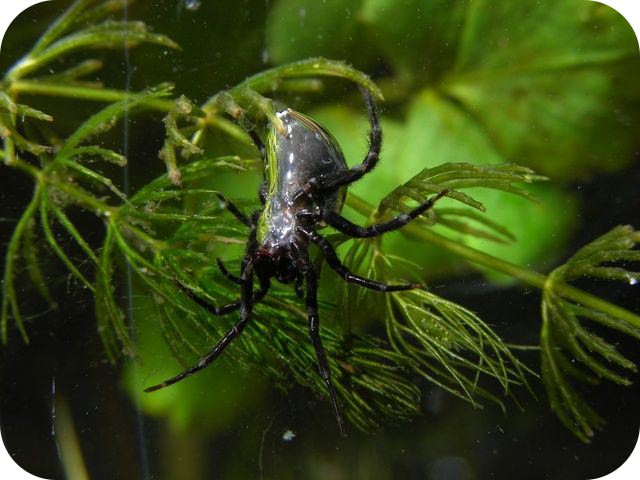
Underwater Spiders
In the ponds of northern Europe lives a tiny brown spider that spends its entire life underwater. But just like land spiders, it needs oxygen to breathe. So, how does this spider survive beneath the surface? Unlike fish, it does not have gills. Instead, the diving bell spider (Argyroneta aquatica) creates a special underwater air pocket to help it breathe.
The spider weaves a silken dome among underwater plants and fills it with air by carrying bubbles from the surface, which cling to its hairy abdomen. This “diving bell” acts like an external lung, slowly absorbing oxygen from the surrounding water while releasing carbon dioxide. Thanks to this ability, the spider can stay submerged for up to 24 hours before needing to refresh its air supply.
Arthropod Reproduction
Arthropods have a life cycle with sexual reproduction. Most species go through larval stages after hatching. The larvae are very different from the adults. They change into the adult form in a process called metamorphosis. This may take place within a cocoon. A familiar example of metamorphosis is the transformation of a caterpillar (larva) into a butterfly (adult). Other arthropod species, in contrast, hatch young that look like small adults. These species lack both larval stages and metamorphosis.
An Extinct Arthropod
Trilobites are an extinct marine arthropod. You can see one in the fossil pictured below.

Classification of Arthropods
Living arthropods are divided into four subphyla. They are described in Table below. The Hexapoda subphylum includes mainly insects. There are so many insects and they are so important that they are described in greater detail below.
| Subphylum (includes) | Description | Example |
|---|---|---|
| Myriapoda(centipedes, millipedes) | terrestrial; herbivores or predators; 10–400 walking legs; poison claws for hunting |
centipede  |
| Chelicerata (spiders, scorpions, mites, ticks, horseshoe crabs, sea spiders) | mainly terrestrial; predators or parasites; 8 walking legs; appendages called chelicerae for grasping prey; poison fangs for killing prey; no mandibles, maxillae, antennae; two body segments |
spider  |
| Crustacea (lobsters, crabs, shrimp, barnacles, krill) | mainly aquatic, predators, scavengers, or filter feeders; two pairs of antennae and claws for hunting; unique larval stage (called “nauplius”) with head appendages for swimming |
lobster  |
| Hexapoda (ants, flies, grasshoppers, beetles, butterflies, moths, bees, springtails) | mainly terrestrial or aerial; herbivores, predators, parasites, scavengers, or decomposers; 6 walking legs; many modified appendages, such as wings for flying |
beetle  |
Insects
Most members of the subphylum Hexapoda are insects (class Insecta). In fact, more than half of all known organisms are insects. There may be more than 10 million insect species in the world, most of them yet to be identified. It’s clear that insects, and not humans, dominate life on Earth.
Structure and Function of Insects
Insects range in length from less than a millimeter to about the length of your arm. They can be found in most habitats, but they are mainly terrestrial. Many can fly, so they are also aerial. Like other arthropods, insects have a head, thorax, and abdomen. They have a wide variety of appendages, including six legs attached to the thorax. Insects have a pair of antennae for “smelling” and “tasting” chemicals. Some insects can also use their antennae to detect sound. Other sensory organs on the head include several simple eyes and a pair of compound eyes. The compound eyes let insects see images. Butterflies and bees can even see in color. For feeding, the head contains one pair of mandibles and two pairs of maxillae. Insects consume a wide range of foods, and their mouthparts have become specialized. Several variations are shown in Figure below.

An insect’s abdomen contains most of the internal organs. Like other arthropods, insects have a complete digestive system. They also have an open circulatory system and central nervous system. Like other terrestrial arthropods, they have trachea for breathing air and Malphigian tubules for excretion.
Insect Flight
Insects are the only invertebrates that can fly. Flight has important advantages. It’s a guaranteed means of escape from nonflying predators. It also aids in the search for food and mates. Insects generally have two pairs of wings for flight. Wings are part of the exoskeleton and attached to the thorax. Insect wings show a lot of variation. As you can see in Figure below, butterfly wings are paper-thin, whereas beetle wings are like armor. Not all insect wings work the same way, either. They differ in how the muscles are attached and whether the two pairs of wings work independently or together. Besides flight, wings serve other functions. They may protect the body (beetles), communicate visually with other insects (butterflies), or produce sounds to attract mates (katydids).

Insect Reproduction
Nearly all insects reproduce sexually. Some can also reproduce asexually. An example of an insect life cycle is shown in Figure below.

Insect Life Cycle. This diagram represents the life cycle of a fly. Most insects have a similar life cycle.
When an insect egg hatches, a larva emerges. The larva eats and grows and then enters the pupa stage. The pupa is immobile and may be encased in a cocoon. During the pupa stage, the insect goes through metamorphosis. Tissues and appendages of the larva break down and reorganize into the adult form. Metamorphosis is actually very advantageous. It allows functions to be divided between life stages.
Insect Behavior
Insects are capable of a surprising range of behaviors. Most of their behaviors, such as flying and mating, are instinctive. These are behaviors that don’t need to be learned. They are largely controlled by genes. However, some insect behaviors are learned. For example, ants and bees can learn where food is located and keep going back for more.
Many species of insects have complex social behaviors. They live together in large, organized colonies (see Figure below). This is true of ants, termites, bees, and wasps. Colonies may include millions of individual insects. Colony members divide up the labor of the colony. Different insects are specialized for different jobs. Some reproduce, while others care for the young. Still others get food or defend the nest.

Living in a large colony requires good communication. Ants communicate with chemicals called pheromones. For example, an ant deposits pheromones on the ground as it returns to the nest from a food source. It is marking the path so other ants can find the food. Honeybees communicate by doing a “waggle dance.”
KQED: Ants: The Invisible Majority
Most of us think ants are just pests. But not Brian Fisher. Known as “The Ant Guy,” he’s on a mission to show the world just how important and amazing these little creatures are and in the process, catalog all of the world’s 30,000 ant species before they become casualties of habitat loss.
Ladybugs, also known as ladybird beetles, have a life cycle of four to six weeks. In one year as many as six generations of ladybird beetles may hatch. In the spring, each adult female lays up to 300 eggs in small clusters on plants where aphids are present. After a week the wingless larvae hatch. Both the ladybird beetle larvae and adults are active predators, eating only aphids, scales, mites and other plant-eating insects. The ladybugs live on the vegetation where their prey is found, which includes roses, oleander, milkweed and broccoli. Adult ladybugs don’t taste very good. A bird careless enough to try to eat one will not swallow it.
By late May to early June, when the larvae have depleted the food supply, the adults migrate to the mountains. There, they eat mainly pollen. The ladybugs gain fat from eating the pollen, and this tides them over their nine-month hibernation. Thousands of adults hibernate overwinter in tight clusters, called aggregates, under fallen leaves and ground litter near streams. In the clear, warmer days of early spring, the ladybugs break up the aggregates and begin several days of mating. Learn about ladybugs in this video:
Insects and Humans
Most humans interact with insects every day. Many of these interactions are harmless and often go unnoticed. However, insects cause humans a lot of harm. They spread human diseases. For example, the deadly bubonic plague of the middle ages was spread by fleas. Today, millions of people die each year from malaria, which is spread by mosquitoes. Insects also eat our crops. Sometimes they travel in huge swarms that completely strip the land of all plant material (see Figure below). On the other hand, we depend on insects for the very food we eat. Without insects to pollinate them, flowering plants—including many food crops—could not reproduce.

A video that shows a locust swarm:
Honeybees are one of the most well-known insects on the planet. Bees are naturalized on every continent except Antarctica. Honeybees have a highly developed social structure and depend on their community, or colony, for survival, with a colony containing up to 20,000 bees. When bees search plants for nectar, pollen sticks to the fuzzy hairs that cover their hind legs. At the next flower, some of the pollen rubs off and fertilizes that flower. In this way, bees help improve fruit production.
Bees pollinate an estimated 130 different varieties of fruit, flowers, nuts and vegetables in the United States alone. Farmers obviously depend on bees to pollinate crops, such as fruit and nuts, but in recent years thousands of bee colonies have disappeared. This could be a devastating issue for farmers. Can anything be done? Meet two Northern California researchers looking for ways to make sure we always have bees to pollinate our crops in this video:
Lesson Summary
- Arthropods are the largest phylum in the animal kingdom. Most arthropods are insects. The phylum also includes spiders, centipedes, and crustaceans. The arthropod body consists of three segments with a hard exoskeleton and jointed appendages.
- Insects are arthropods in the class Hexapoda. They are the most numerous organisms in the world. Most are terrestrial, and many are aerial. Insects have six legs and a pair of antennae for sensing chemicals. They also have several eyes and specialized mouthparts for feeding. Insects are the only invertebrates than can fly. Flight is the main reason for their success. Insects may live in large colonies and have complex social behaviors. Insects spread disease and destroy crops. However, they are essential for pollinating flowering plants.
Lesson Review Questions
Recall
1. Identify distinguishing traits of most arthropods.
2. What is molting? Why does it occur?
3. Name three arthropod head appendages and state their functions.
4. Describe two structures that allow arthropods to breathe air.
5. List several traits that characterize insects.
6. State two important advantages of flight in insects.
7. Give examples of insect behavior.
Apply Concepts
8. Assume you see a “bug” crawling over the ground. It has two body segments and lacks antennae. Which arthropod subphylum does the “bug” belong to? Explain your answer.
Think Critically
9. Present facts and a logical argument to support the following statement: Insects dominate life on Earth.
10. Relate form to function in the mouthparts of insects.
11. Explain why distinctive life stages and metamorphosis are helpful.
Points to Consider
The invertebrates described so far in this chapter are protostomes. They differ from the other major grouping of animals, the deuterostomes, in how their embryos develop. The next lesson describes invertebrates that are deuterostomes. These invertebrates are more closely related to vertebrates such as humans. Some of these invertebrates are even placed in the chordate phylum.
- What traits do you think might characterize deuterostome invertebrates?
- How might chordate invertebrates differ from nonchordate invertebrates?
Previous: Mollusks and Annelids
Next: Echinoderms and Invertebrate Chordates

Licensed under
CK-12 Foundation is licensed under Creative Commons AttributionNonCommercial 3.0 Unported (CC BY-NC 3.0)”
• Terms of Use • Attribution
Changes/edits were made to the original ck12 biology text by Guest Hollow. Changes are not endorsed by ck12 in any way.
I nearly blew out my speakers with the CMI video…?
LOL 🙂
the ted ed cicada video link doesn’t appear to work
there is also a youtube link at the end of the bees and bread paragraph that doesnt work
Thank you SO much for taking the time to comment and let us know about these links! I’ll get them fixed up asap! <3
the kqed link for ants cant be found
actually it appears none of the kqed links work
Thanks again for leaving the comments and letting us know! I’ve fixed the broken videos/links. 🙂 We really appreciate you!!
There’s a very small sentence under the Arthropod Head Diagram that references evolution: “Arthropod Head. Arthropods have evolved a variety of specialized appendages and other structures on their head.” Just thought that I would let you know.
Thank you SO much for catching that! I just removed it. You are so appreciated! 🙂
Why is the information regarding evolution removed?
Because this is a Christian-centric text-book.
We’ve taken the rigorous CK-12 biology textbook and edited it (thanks to a Creative Commons license) to fit a Christian creationist perspective. Edits are as follows:
References to evolution were taken out.
New videos were added. Students can watch them right from the online text!
Christian material was added.
Definitions were placed with vocabulary words in the beginning of each chapter.
New pictures and illustrations were added.
Custom illustrations were created to better communicate concepts.
Additional concepts and material were added.
Some humor was added and/or sections were rewritten to be more clear and understandable.
Latin and Greek root word “alerts” were created and inserted in the text – a fun way to learn vocabulary using science!
The human anatomy portion was taken out. We don’t believe several weeks study is adequate for a rich understanding of the human body. Check out our high school anatomy curriculum that fills this need.
We edited the workbook to make it more visual with added humor and edits that reflect the changes in the Guest Hollow version of the textbook.
We also added a schedule that ties in a variety of lab options, activities, videos, workbook assignments, games, free printables, additional books, and more to make a rich learning experience that goes beyond the text!
See: https://guesthollow.com/store/high-school-biology-curriculum/
Guest Hollow’s Biology is a free online *Christian homeschool biology curriculum. The course incorporates a free high-quality textbook, numerous online videos, tons of labs (with a multitude of budget and interest options), living books, a no-cost printable workbook with answer key, an independent study schedule, and more! It even incorporates Greek and Latin roots vocabulary! See the following link for more info:
https://guesthollow.com/an-alternate-way-to-use-our-biology-curriculum-2/
*Secular families can also use our schedule with the original CK-12 biology book.
The info in the text about the diving bell spider doesn’t match what the video says. The video says he does have book lungs, not gills and the text contradicts this.