
Click here to return to the Botany Textbook table of contents.
Chapter 6: Roots: The Hidden Half of the Plant

Picture this: You’re pulling weeds in the garden on a hot summer day. You grab what looks like a small dandelion and give it a yank. Instead of popping out easily, you feel resistance. You pull harder. The leafy tops breaks off in your hand, leaving the root still buried deep in the soil. Frustrated, you grab a trowel and start digging. And digging. And digging. That “small” dandelion has a root that goes down nearly a foot!
Meanwhile, across the yard, you try pulling up a clump of grass. It comes out relatively easily, bringing with it a dense mat of thin, tangled roots that spread in all directions like a mop head. The dandelion had one thick root going deep. The grass has dozens of thin roots spreading wide.
Welcome to the hidden world of roots, the unsung heroes of the plant kingdom! While flowers and leaves get all the attention, roots are doing the real heavy lifting underground.
They’re the foundation that anchors plants in place, the straws that absorb water and nutrients, the warehouses that store food, and the explorers that navigate through soil searching for resources.
You’ll discover why roots are far more impressive than most people realize, and how they pull off amazing feats of engineering without a brain, muscles, or a single moving part.
The Basic Plant Body Plan
Whether you’re looking at a blade of grass or a giant redwood tree, they’re all built using the same basic game plan. It’s like how every car has an engine, wheels, and a steering wheel, even though a Ferrari looks nothing like a pickup truck.
Plants divide their bodies into two teams, and each team has a completely different job:

- Underground crew (the root system): This is everything you don’t see – the main roots, their branches, and millions of microscopic root hairs. While you’re walking around above ground, roots are down there anchoring the plant like tent stakes, slurping up water and minerals, and often stockpiling food for later. They’re the crew doing all the heavy lifting down in the dark.
- Above-ground crew (the shoot system): This is the showy stuff – stems, leaves, buds, flowers, and fruits. While roots are working in the basement, shoots are up top running the solar panels (leaves), building the framework (stems), and making babies (flowers and fruits).
Neither team can survive without the other. Roots need the food that leaves make through photosynthesis. Leaves need the water and minerals that roots absorb. It’s the ultimate partnership – one team works underground in the dark, the other works above ground in the sun, and together they keep the whole operation running.
In this chapter, we’re going deep (literally!) into the underground world of roots. We’ll explore the above-ground framework (stems) in the next chapter, and the solar panel system (leaves) in the chapter after that. But for now, let’s dig into what’s happening beneath your feet!
Why Roots Matter
Here’s a problem: most roots are invisible (although we’ll be talking about some that aren’t in the next chapter). Unless you’re actively digging in the garden or pulling weeds, you never see them. This creates an “out of sight, out of mind” situation where people forget just how important and impressive roots really are.
But here’s a crazy fact: in many plants, the root system is actually LARGER than the above-ground parts! A single rye plant grown in a laboratory was carefully excavated and measured. Scientists found it had 387 miles of roots with nearly 14 billion root hairs! If you laid all those roots end to end, they’d stretch from New York to Indiana (if you went in a straight line)!
Even a simple grass plant in your lawn might have roots that go down 6-8 inches, creating a dense underground network. That’s why grass is so good at holding soil in place and preventing erosion (the wearing away of soil by wind and water). Without grass roots holding it together, rain would wash the soil away and wind would blow it away.
Some plants have truly impressive root systems:
- Mesquite trees in the desert can have taproots reaching 100-190 feet deep (in exceptional cases) to access underground water. That’s deeper than a 10-story building is tall!
- Banyan trees send down aerial roots from their branches that eventually become additional trunks, allowing one tree to spread over acres.
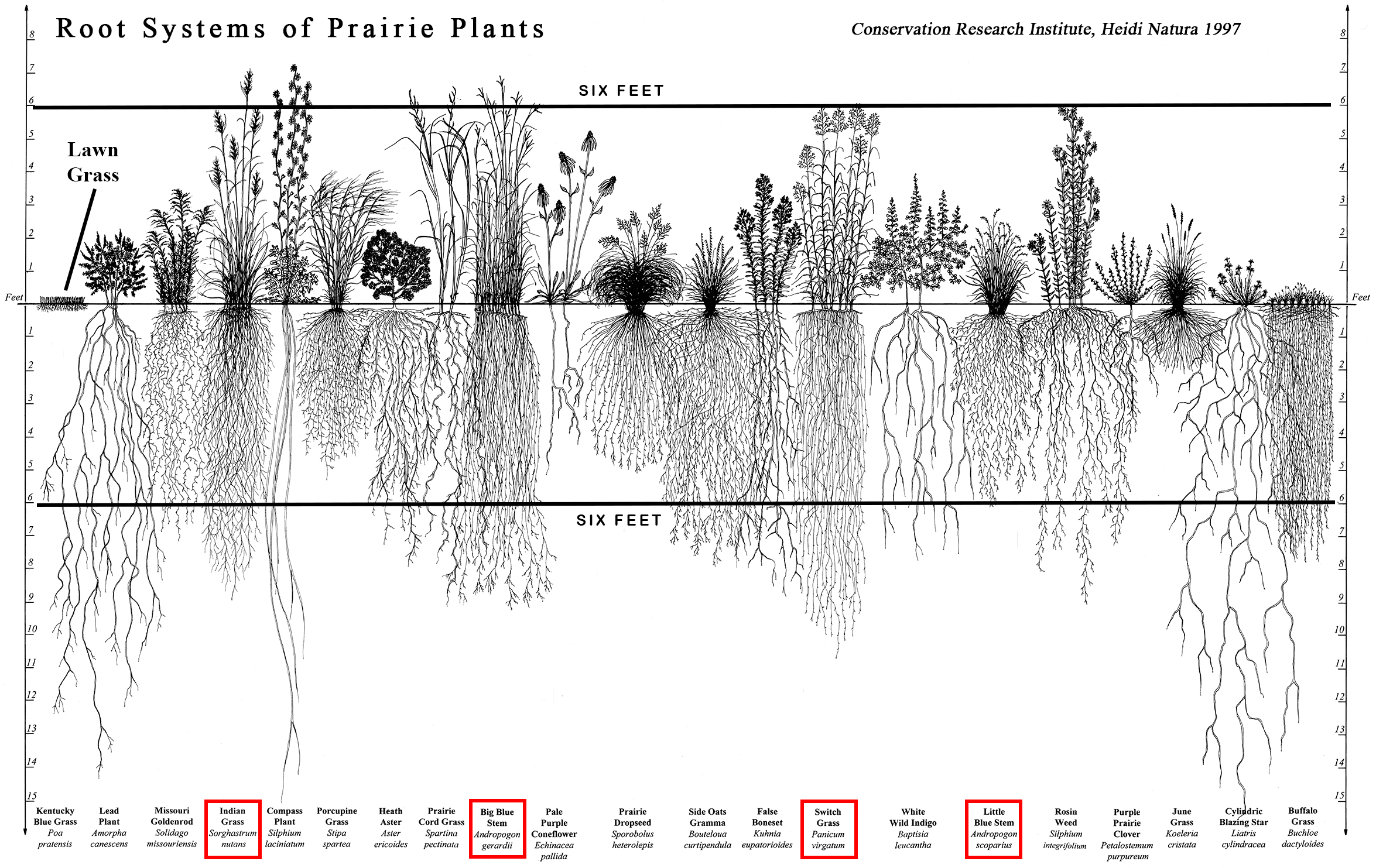
- Prairie grasses can have root systems that extend 6-15 feet deep, which is why prairie soil is so rich and stable. Compare that to lawn grasses whose roots go down about 4-10 inches at most. Click here for a picture (look at the far left to see the lawn grass).

If you’ve ever studied the Dust Bowl of the 1930s in the United States, this difference in root systems suddenly matters a lot.
Before large areas of the Great Plains were plowed up for farming, they were covered in native prairie grasses with incredibly deep, tangled root systems. Those roots acted like a living net, gripping the soil, holding moisture underground, and keeping the land stable even during dry years. When drought hit, the soil stayed put because it was literally stitched together by plant roots.
But when those deep-rooted prairie grasses were removed and replaced with shallow-rooted crops and lawn-style grasses, the soil lost its anchor. During the severe drought of the 1930s, strong winds had nothing holding the dry topsoil in place. The result was massive dust storms that stripped fields bare, buried homes, and forced thousands of families to leave their farms.
The Dust Bowl wasn’t just a weather problem. It was a plant-roots problem.
So roots aren’t just holding up one plant at a time. As the Dust Bowl showed, they can hold an entire region together, and when they’re gone, history takes notice. What’s happening underground often matters far more than what we see above the surface!
Roots work around the clock, even while you sleep. They’re constantly absorbing water, taking up nutrients, anchoring the plant against wind and gravity, and in many cases, storing food for future growth. Without roots, there would be no plants. And without plants, there would be no us!
The Four Jobs of Roots
Roots are multitaskers extraordinaire. They have four main functions, and most roots do all four simultaneously!
Job 1: Anchorage: Keeping Plants from Blowing Away
A massive oak, several tons of wood with branches spread wide like an enormous umbrella, stands firm through a windstorm that could knock you off your feet. What’s holding it down? An underground grip system so powerful it would make a rock climber jealous.
Roots don’t just sit there looking like dirty spaghetti. They’re nature’s anchor crew, wrestling with wind, rain, and gravity to keep plants exactly where they belong. And here’s the wild part: that oak tree you’re admiring? Its root system might stretch 2-3 times wider than all those branches you can see and weigh as much as the entire tree above ground. It’s like having a whole secret tree hidden underground!

The Root That Refused to Die
Ever battled a dandelion in your yard? You yank it out, feel victorious… then watch in horror as it pops back up a week later like nothing happened. Here’s why you can’t win: dandelion roots can plunge up to 6.5 feet underground (though most are shorter, because even dandelions aren’t usually that ambitious). Break off the top? No problem. That leftover root chunk underground will just regenerate the whole plant like some kind of botanical phoenix (a fabled bird that was said to burst into flames and then rise again from its own ashes). Cut it down, and it comes back anyway, powered by what was left behind. That’s frustrating for gardeners and impressive for botanists.
Job 2: Absorption: The Plant’s Drinking Straws and Nutrient Miners
Roots are the plant’s water and mineral intake system. They absorb water and dissolved nutrients from the soil and send them up to the rest of the plant. Without roots doing this job nonstop, plants would die of thirst in days.
But roots don’t just passively soak up whatever’s around them. They actively seek out water and nutrients! If one side of the root system finds a pocket of moisture, the roots will grow preferentially in that direction. It’s like the plant is “hunting” for water underground.
This seeking behavior is so strong that tree roots will invade water pipes and sewer lines if they detect moisture. The roots sense the water, grow toward it, and then exploit any tiny crack to get inside. Once inside, they can grow into thick mats that completely clog the pipes like the picture below!

What roots are hunting for underground
What’s a plant mostly made of? If you guessed plant stuff, you’re technically right but also hilariously wrong. Plants are basically walking water balloons. Some are up to 95% water! That means roots aren’t just chilling underground. They’re running the most important scavenger hunt of the plant’s life: Find water or die trying.

Here’s the plant’s problem: it can’t just fill up once like a car’s gas tank and cruise along. Water is constantly evaporating from its leaves (through transpiration, more on that later). Imagine trying to keep a bucket full when it has a hole in the bottom. That’s a plant’s life. Roots have to hustle 24/7 to replace that lost water, or game over.
Ever wonder what wilting actually is? Here’s the behind-the-scenes horror show:
Remember those water balloon cells we mentioned? When they’re fully inflated, they press against each other like a crowd at a concert: firm, tight, holding everything up. The plant stands tall and looks healthy. But when water levels drop, those cells deflate like sad birthday balloons. They get floppy. The whole plant droops into a depressing heap.
This isn’t permanent death (yet), though! Give that wilted plant a good drink, and it’s like watching a time-lapse resurrection. The cells refill, reinflate, and boom! The plant pops back up like nothing happened. Cell pressure saves the day again.
Water: The Plant’s Everything
Water isn’t just about staying inflated. It’s also the plant’s internal Amazon delivery service, carrying dissolved minerals from roots to leaves. Plus, it’s the liquid where all the plant’s chemical reactions happen (the pool where the metabolic party takes place). No water? The entire operation shuts down. Every chemical reaction stops. It’s lights out.
So next time you see roots snaking through soil, remember: they’re not just anchoring. They’re running an around-the-clock emergency water operation to keep billions of cells inflated, fed, and functioning. It’s the ultimate survival mission, and failure is not an option.
The Mineral Hunt: Why Plants Are Basically Rock Eaters
Plants need at least 16 different minerals from soil to stay healthy, just like you need vitamins in your food. But here’s the weird part: those minerals come from rocks. Yes, rocks. Plants are basically eating crushed-up rocks. The exception is nitrogen, which we’ll discuss in a minute.
Over hundreds or thousands of years, rocks slowly crumble into smaller and smaller pieces. Rain dissolves them, ice cracks them apart, wind grinds them down, and plant roots even help break them up. As rocks disintegrate, they release the minerals locked inside them into the soil. This is why soil in different places grows different things. Granite-rich areas have totally different nutrients than limestone-rich areas. Location matters!
The Big Three: NPK (The Plant Survival Trio)
Ever stared at a fertilizer bag and seen three numbers like “10-10-10” or “20-5-10”? Those numbers represent the three most critical minerals plants need: nitrogen, phosphorus, and potassium (NPK for short). Think of them as the plant version of protein, carbs, and healthy fats.

Nitrogen: The Green Machine (With a Weird Twist)
Nitrogen is what makes grass brilliantly green and lettuce leaves lush and healthy. But here’s the absolutely bonkers part: nitrogen is literally everywhere around us. The air you’re breathing right now is 78% nitrogen! So why can’t plants just grab it from the air like we grab oxygen?
Because they need translators.
Special bacteria living in the soil have a superpower: they can snatch nitrogen from the air and convert it into a form plants can actually use. These bacteria are like the ultimate middlemen. They grab nitrogen from the air, transform it, and release it into the soil. Then plant roots suck it up.
The story doesn’t end there. Once plants absorb nitrogen, it becomes part of their leaves, stems, and roots. When animals eat those plants, the nitrogen moves into the animal’s body. When plants and animals die and decompose, the nitrogen goes back into the soil where new plants can use it again.
But here’s the part most people never hear about: nitrogen doesn’t stay trapped in the soil forever. A different group of bacteria, called denitrifying bacteria, live in soggy, low-oxygen soil, like the bottom of a waterlogged field or a swamp. They break apart the nitrogen compounds hiding in the soil and release nitrogen gas straight back up into the air, the exact same gas that makes up most of what you’re breathing right now. That’s the step that finally closes the loop.
So, nitrogen keeps cycling: air → bacteria → soil → plants → animals → back to soil → denitrifying bacteria → back to air again. It’s like nitrogen is on a merry-go-round that never stops! That’s why nitrogen is different from other minerals. Phosphorus and potassium come from rocks breaking down. But nitrogen comes from the air, gets used by living things for a while, and then eventually heads right back to the air to start the whole ride over again.
Phosphorus: The Root Builder and Baby Plant Maker
Phosphorus is all about growth and reproduction. Without enough phosphorus, plants develop weak, stunted roots and struggle to produce flowers and seeds. It’s especially crucial for vegetables like tomatoes and peppers that need to make lots of fruit. No phosphorus? No tomatoes. It’s that simple.
Potassium: The Plant’s Health Insurance
Potassium is the quiet one of the trio. It helps plants use water efficiently (critical during drought!) and strengthens their defenses against diseases and pests. Plants low on potassium often have weak stems and are way more likely to get sick. Think of it as the plant’s immune system booster.
The Supporting Cast
Plants also need smaller amounts of other minerals like:
- Calcium – helps build strong cell walls (the same mineral that makes your bones strong!)
- Magnesium – needed to make chlorophyll (the green stuff in leaves)
- Iron – helps plants make chlorophyll and stay green
A quick note about magnesium vs. iron:
Magnesium is actually part of the chlorophyll molecule. Picture chlorophyll as a tiny green machine with one atom locked right in the center, holding the whole structure together. That center atom is magnesium. No magnesium, no chlorophyll molecule, period. It’s like trying to build a car with no engine. You can have every other part lying around in perfect shape, but the car just isn’t going anywhere.
Iron works differently. It never actually becomes part of chlorophyll, but plants can’t assemble the molecule without it. Think of iron as the construction crew that shows up, builds the thing, and then leaves once the job’s done. Take iron away, and the assembly line grinds to a stop, even if the plant has plenty of magnesium just sitting there waiting to be used.
That’s why a magnesium shortage and an iron shortage can look almost identical from the outside. Both cause leaves to fade from green to pale yellow (a problem called chlorosis) because the plant simply can’t keep making chlorophyll. But the reason behind the yellowing is different every time: one plant is missing a building block, and the other is missing its builder.
Without the minerals mentioned above, plants get sick, just like you would on a junk food diet with zero vitamins. That’s why some farmers and gardeners add fertilizer (or compost) to soil. It replaces minerals that plants have used up! Fertilizer is basically a multivitamin for plants.
The absorption of water and minerals is so critical that plants have an amazing structure to maximize it: root hairs! We’ll learn all about these microscopic marvels soon.
A Quick Word About Compost: Nature’s Recycling Program
You’ve probably heard people talk about compost like it’s some kind of gardening magic, and honestly? It kind of is. Compost is what happens when you let organic stuff (fruit peels, dead leaves, grass clippings, vegetable scraps) rot in a controlled way. Bacteria, fungi, and other decomposers break it all down into dark, crumbly, soil-like material that smells like a forest floor.


Here’s why compost is different from store-bought fertilizer: Fertilizer is like taking a vitamin pill. It gives plants a quick hit of specific minerals (usually just nitrogen, phosphorus, and potassium), but that’s it. Compost, on the other hand, is like eating a massive, nutritious home-cooked meal. It adds dozens of different minerals slowly over time as it continues breaking down. It also improves soil structure, helps soil hold water better, feeds beneficial soil organisms, and adds organic matter that makes the whole underground ecosystem healthier.
Think of fertilizer as fast food (quick energy, limited nutrition) and compost as a slow-cooked feast (takes longer, but way better for you in the long run). Many gardeners use both, but compost builds healthy soil that keeps giving for years, while fertilizer is more of a quick fix. We’ll dive way deeper into composting and soil health in Chapter 29, but for now, just know that compost is basically recycled life feeding new life. It’s the circle of life, but underground and slightly less dramatic than The Lion King.
Job 3: Storage: The Plant’s Underground Pantry
Here’s a clever survival trick: many plants turn their roots into underground food vaults. This is especially handy for plants that need to survive brutal winters or long droughts when growing conditions are terrible
Ever wonder why we eat so many root vegetables? We’re literally raiding the plant’s emergency food supply! Carrots pack their taproot full of sugars (remember from Chapter 1 how we bred them from those skinny, bitter wild carrots into the sweet orange ones we know today?). Sweet potatoes stuff their roots with starch. Beets stockpile nutrients in their swollen roots. Radishes create spicy storage roots. Turnips and parsnips do the same thing.

The Starch Trick
But wait – why do plants store starch instead of just storing sugar? Here’s where it gets interesting.
When plants make sugar through photosynthesis (we’ll learn about this later), they often make way more than they need right away. It’s like earning more money than you can spend. So what do they do? They convert the extra sugar into starch and pack it away for later.
Think of starch as sugar’s more practical cousin. Sugar dissolves in water and would just wash away or leak out of storage cells. Starch doesn’t dissolve, so it stays put. Sugar takes up a lot of space. Starch is more compact – you can pack way more energy into the same space. Sugar attracts pests and can spoil. Starch is stable and doesn’t attract unwanted attention.
When the plant needs energy later (like to shoot up a flower stalk in spring or survive a harsh winter), it converts the starch back into sugar and burns it for fuel. It’s like withdrawing money from your savings account when you need it!
You’re eating plant savings accounts
Every time you eat potatoes, sweet potatoes, rice, bread, pasta, or corn, you’re eating starch – the plant’s stored energy. Your body breaks that starch down into sugar, which gives you energy to run around, think, and grow. So, when you bite into a sweet potato, you’re literally eating the energy that plant was saving up to make flowers next spring. We just harvest it first!
Fun fact: If you chew a plain cracker or piece of bread for a long time, it starts to taste sweet. That’s because enzymes in your saliva are breaking down the starch into sugar! Try it sometime!
What are enzymes?
Enzymes are special proteins that act like tiny molecular scissors or tools inside your body (and inside plants too!). Their job is to speed up chemical reactions that would otherwise take forever.
Think of it this way: Imagine you have a big stack of papers that need to be cut into confetti. You could tear them by hand, which would take hours, or you could use scissors, which makes it super fast. Enzymes are like those scissors – they make chemical reactions happen much faster.
In your mouth, you have an enzyme called amylase in your saliva. When you chew bread or crackers, the amylase enzyme breaks apart the long starch molecules (which don’t taste sweet) into smaller sugar molecules (which do taste sweet). The longer you chew, the more starch gets broken down into sugar, so the sweeter it tastes!
Your body has thousands of different enzymes, each one designed to do a specific job:
‣ Some enzymes in your stomach break down proteins from meat
‣ Some enzymes in your intestines break down fats
‣ Some enzymes help your cells produce energy
Plants have enzymes too! They use enzymes to:
‣ Convert starch back into sugar when they need energy
‣ Build cell walls
‣ Make chlorophyll
‣ Defend against diseases
Without enzymes, the chemical reactions in your body and in plants would happen so slowly that life wouldn’t be possible. Enzymes are like the workers in a factory, making sure everything runs smoothly and quickly!
The Two-Year Plan
Many root vegetables are biennials, which just means they live for two years. But those two years couldn’t be more different!
Year 1: The stockpiling phase. The plant sprouts from seed, grows leaves, and pours every bit of energy into building a massive storage root underground. It’s like a squirrel frantically gathering nuts before winter. The plant isn’t trying to flower or make seeds yet. It’s just eating, growing, and stuffing that root full of stored energy.
Year 2: The grand finale. The plant uses all that stored energy to shoot up a tall flower stalk, produce flowers, make seeds, and then die. Mission accomplished. The plant sacrifices itself to create the next generation.
Here are some biennial root storage plants:
 |  |  |  |
| Beets | Carrots and Parsnips | Turnips | Radishes |


Why We Harvest in Year 1
This is the key: we harvest biennial vegetables like carrots at the end of year 1, when the root is absolutely packed with stored food. We’re stealing the plant’s savings before it has a chance to spend them!
Want to see something wild? Leave a carrot in the ground through winter. The next spring, it’ll send up a tall flower stalk with delicate white flowers. Pretty! But if you dig up that carrot now, you’ll find a tough, woody, shriveled-up root that tastes terrible. Why? The carrot burned through all its stored energy to make that flower stalk and seeds. The root is basically an empty husk now, like a deflated balloon. The plant accomplished its mission (making seeds), but the root is worthless for eating.
The wild side
Storage roots aren’t just a farm thing. Wild plants use this trick too. Dandelions store energy in their taproot, which is why they can regrow even after you mow them down (the root survives underground and sends up new leaves). Prairie plants stockpile nutrients in their roots to survive brutal winters and explode back to life in spring. Desert plants may store water in swollen roots to survive months without rain.
It’s all about survival. Store energy when times are good, use it when times are tough.
Job 4: Vegetative Reproduction: Making Baby Plants
Some plants can produce new plants from their roots! This is called vegetative reproduction. It’s like the plant is cloning itself.
For example: Aspen trees send up new shoots from their roots, creating entire groves that are genetically identical. The largest known organism on Earth is actually a grove of quaking aspen trees in Utah called “Pando” (Latin for “I spread”). It covers 106 acres and consists of about 47,000 stems, all connected by one massive root system. It’s essentially one giant plant that weighs about 6,000 tons!
Many a gardener has grumbled when the Aspen tree in their yard has sent babies (clones) into their vegetable or flower gardens!

Blackberry bushes spread through root suckers (new shoots emerging from roots). This is why blackberry patches expand so aggressively and can become a tangled mess as shown in the picture below:

Canada thistle and other weeds are nearly impossible to eliminate because any root fragment left in the soil can sprout a whole new plant. You have to get every single piece of root, or it will regenerate!
Root Structure and Anatomy
Let’s take a close look at a root, starting from the tip and working our way up. Understanding root structure will help you appreciate just how sophisticated these underground organs really are.
The Root Cap: Nature’s Hard Hat
At the very tip of every growing root is a structure called the root cap. This is a thimble-shaped cluster of cells that protects the delicate apical meristem (remember those “forever young” cells from Chapter 4?) as the root pushes through soil.

Think about what roots have to do: they have to shove their way through dirt, pushing aside soil particles, rocks, and other obstacles. That’s rough work! The root cap takes the beating so the precious meristem cells behind it don’t get damaged.
Here’s the amazing part: root cap cells are constantly being worn away by friction with the soil, but the apical meristem keeps producing new ones to replace them. It’s like having a self-repairing hard hat! The root cap cells also secrete a slimy substance called mucilage that lubricates the root tip, helping it slide through soil more easily. Think of it as nature’s WD-40!

Mucilage comes from the Latin word mucus meaning slime, mold, or sticky fluid.
-age comes from French and it’s used in English to mean a substance or a collection of something.
Put together, mucilage literally means a slimy or sticky substance, which fits how plant mucilage feels. It’s kind of like plant snot.

What is WD-40? WD-40 is a spray lubricant (slippery liquid) that people use to make things slide smoothly and to stop squeaky hinges. The name stands for “Water Displacement, 40th formula” because it took 40 tries to get the formula right! You might have seen the blue and yellow can in your garage. People spray it on stuck bolts, squeaky door hinges, and rusty bike chains to make them work smoothly again. Just like WD-40 makes metal parts slide easily, the root’s mucilage makes it easier for the root to push through hard, packed soil.
The root cap also has another important job: it contains specialized cells that can sense gravity. These cells contain starch-packed structures called amyloplasts that settle to the bottom of the cell (like sand settling in water), telling the root which way is down. This is how roots know to grow downward even if you plant a seed sideways!
The Three Growth Zones: Root Construction in Action
Behind the root cap, the root is divided into three zones where wildly different things are happening. Think of it like an assembly line where raw materials get transformed into a finished product. These zones blend into each other, but each has a specific mission:
Zone of Cell Division: The Baby Factory
This is where the root apical meristem lives, and it’s absolute chaos. Cells here are dividing like crazy through mitosis (making copies of themselves), cranking out new cells that will become the rest of the root.
This zone is only a few millimeters long, but it’s the growth engine powering the entire root. Some of the cells produced here stay put and keep dividing. Others get shipped forward to replace worn-out root cap cells that sacrificed themselves. Still others move backward into the next zone where things get really interesting.
Zone of Elongation: The Stretch Zone (Where Growth Actually Happens)
This is where the magic happens! The cells from the division zone move here and start to stretch out like pulling taffy. They can elongate to 10 or even 20 times their original length. Imagine if you woke up tomorrow and you were suddenly 100 feet tall. That’s basically what these cells are doing.
In the following picture, the zone of elongation is where the #5 is.

This stretching is what actually pushes the root deeper into the soil. The zone of elongation is also just a few millimeters long, but those few millimeters of stretching cells can bulldoze a root through surprisingly hard soil!
How does a cell stretch itself?
Here’s the trick: it chugs water into its central vacuole (the cell’s water storage balloon). As the vacuole swells with water, it pushes against the cell walls, stretching them out. The cell walls are still somewhat flexible at this stage, so they can expand. It’s exactly like blowing up a balloon! The water pressure inside (called turgor pressure) pushes the walls outward, making the cell longer and longer.
This is why plants shrivel up and stop growing without water. No water means no cell stretching, and no cell stretching means game over for growth.
Zone of Maturation: Career Day for Cells
This is where cells stop elongating and start specializing. It’s like career day where cells “decide” what they want to be when they grow up. They transform from generic, all-purpose cells into the specialized permanent tissues you learned about in Chapter 5:
- Some become epidermal cells (the outer protective skin)
- Some become cortex cells (the storage warehouse)
- Some become endodermal cells (the security checkpoint controlling what gets in)
- Some become xylem or phloem (the transport highway system)
- Some become root hairs (the absorption specialists we’ll meet soon)
Once cells pick their career path and differentiate, there’s no going back. They’ve committed to their job for life. No career changes allowed.
The zone of maturation extends for the rest of the root’s length. As the root tip keeps growing forward like a tiny drill, the older parts of the root (farther from the tip) are all in this mature, specialized zone, doing their jobs and keeping the plant alive.
Root Hairs: Tiny but Mighty
In the zone of maturation, you’ll find one of the root’s most important features: root hairs!
Root hairs are microscopic extensions of root epidermal cells that stick out into the soil like tiny fingers. Each root hair is actually just one cell that has grown a long extension, kind of like a cell growing a finger that reaches out into the soil.
They’re so small you usually can’t see individual ones with the naked eye, but if you’ve ever gently pulled up a seedling and noticed a fuzzy white coating on the roots, that fuzz is actually millions of root hairs!

Why are root hairs so important? Surface area!
What is surface area? Surface area is the total amount of outside space that something has. Think of it like the amount of wrapping paper you’d need to cover a present.
Without root hairs a root is like a smooth stick. Only the outside of the stick touches the soil water.
With root hairs the root has millions of tiny fingers (root hairs) sticking out in all directions. Now there’s WAY more root surface touching the soil water!
Think about it this way: if you wanted to soak up as much water as possible with a towel, would you rather have the towel:
- Rolled up in a tight ball? (small surface area)
- Spread out flat? (large surface area)
Spread out, obviously! More surface area = more contact with water = more absorption.
Root hairs massively increase the surface area of the root that’s in contact with soil water. A single root hair might only be 1-2 millimeters long and thinner than a human hair, but when you have billions of them, they can increase the root’s absorptive surface area by 10-20 times!
It’s like turning a smooth stick into a fuzzy pipe cleaner. The fuzz (root hairs) gives you way more surface to absorb water!
Here are some amazing root hair facts:
- A single rye plant can have 14 billion root hairs.
- Those root hairs have a combined surface area of 400 square meters (bigger than a basketball court!).
- Root hairs can absorb water and minerals from soil pores smaller than the width of a human hair.
- They grow incredibly fast, sometimes reaching full length in just a few hours.
- They live only a few days or weeks before dying off, but new ones are constantly being produced.
Here’s the catch: root hairs are fragile and short-lived. This is why transplanting can be stressful for plants. When you dig up a plant, you inevitably damage or destroy many root hairs, temporarily reducing the plant’s ability to absorb water. That’s why transplanted plants often wilt at first, even if you water them well. They need time to grow new root hairs!
How Root Hairs Actually Work Their Magic
Root hairs aren’t just sitting there passively soaking up whatever comes their way. They’re actively hunting for what the plant needs, and they use two completely different strategies to do it.
The water trick: Think of a root hair cell like a half-empty water balloon. Water in the soil naturally wants to flow in and fill it up, passing right through the cell’s outer membrane. It’s automatic – no energy required! The cell just has to be “thirstier” than the surrounding soil, and water flows in on its own. This process (called osmosis) happens constantly, as long as there’s moisture in the soil.
The mineral hustle: But minerals? Those require actual work. Root hairs have to actively pump minerals from the soil into the cell, even when there’s barely any out there to find. It’s like the root hair is running a tiny vacuum cleaner, sucking up every speck of nitrogen, phosphorus, and potassium it can find. This takes energy (the plant has to burn food to power these pumps), but it’s worth it. Without this active pumping, the plant would starve even in decent soil because minerals don’t just flow in on their own like water does.
So root hairs are doing two jobs at once: passively collecting water that flows in naturally, while actively hunting down and pumping in minerals. Pretty impressive for a single cell!
Fungus friends – Many root hairs team up with helpful fungi that act like extension cords, reaching even farther into the soil to find water and nutrients. We’ll learn more about these amazing partnerships in the soil and plant partnerships chapter!
Internal Structure: What’s Inside
Want to see something neat? If you slice a root in half and look at it under a microscope, you’ll see it’s built in layers, like an onion. Each layer has a different job. Let’s peel back the layers and see what’s going on!
You can refer to the image below as I discuss the different layers. The blue arrows represent water and nutrients entering the plant from the roots.

Epidermis: The Outer Skin
The outermost layer is called the epidermis.
Epidermis comes from Greek: epi (on top) + derma (skin) = skin on top. That’s why your skin is also called epidermis!
But root epidermis is different from your skin or the epidermis on stems and leaves. Your skin keeps water out. Root epidermis lets water IN! It’s only one cell thick and has no waxy coating, so water and minerals can pass through easily.
Remember those root hairs? They’re just epidermal cells that grew long extensions, like a cell stretching out a finger to grab water from the soil!
Cortex: The Thick Middle Layer
Right inside the epidermis is a thick layer called the cortex. This is the biggest part of most roots, made mostly of parenchyma cells (those versatile storage cells from Chapter 5) with lots of air spaces between them.
When you bite into a carrot, you’re eating the cortex! It’s the orange part packed with stored sugars.
The cortex does three things:
- Stores food (that’s why carrots are sweet and nutritious)
- Moves water from the epidermis toward the center
- Lets roots breathe (the air spaces allow oxygen to reach deeper tissues)
Wait, roots breathe? Yes! They need oxygen just like you do. That’s why overwatering kills plants. Waterlogged soil has no air spaces, so roots suffocate.
Endodermis: The Security Checkpoint
Here’s where it gets interesting. The innermost layer of the cortex is a single row of cells called the endodermis, and it acts like a security checkpoint.
Each endodermal cell has a waxy belt around it called the Casparian strip (named after Robert Caspary, the German botanist who discovered it in 1865). This belt is made of suberin, the same waxy, waterproof substance that makes cork waterproof.
Here’s why this matters: Up until now, water and minerals have been moving through the spaces between cells, kind of like water soaking through a sponge. But the Casparian strip blocks that pathway! It forces everything to pass THROUGH the endodermal cells instead of sneaking BETWEEN them.
It’s like having security guards standing shoulder to shoulder with no gaps. Everyone has to go through the checkpoint. You can’t just walk around it!
Why does the plant need this? Quality control! The endodermis decides what gets into the plant’s plumbing system:
- Good stuff (water and nutrients) gets through
- Bad stuff (toxins and excess minerals) gets blocked
- The plant can regulate how much of each mineral enters
Without this checkpoint, poison could enter the plant’s transport system and kill it!
Pericycle: The Baby Root Factory
Just inside the endodermis is a layer called the pericycle. This layer is special because it keeps some of its meristematic ability (remember those “forever young” cells from Chapter 4?) even after the root has matured.
When the plant needs a new branch root, pericycle cells start dividing and form a baby root. This baby root literally bursts through the cortex, endodermis, and epidermis like a chick hatching from an egg!
This is totally different from how stems make branches. Stem branches grow from buds on the surface. Root branches explode out from deep inside!
Vascular Cylinder: The Plumbing Hub
At the very center of the root is the vascular cylinder (also called the stele), which contains the root’s internal plumbing system: xylem and phloem. Remember those from Chapter 5?
- Xylem transports water and minerals upward from roots to leaves
- Phloem transports sugars and other nutrients in all directions throughout the plant
How Roots Are Different from Stems
Here’s where roots do things their own way. In roots, the xylem forms an X or star shape right smack in the center, with phloem tucked into the spaces between the arms of the X. It looks like a biological asterisk when you slice the root crosswise and peek at it under a microscope.
But in stems (including tree trunks), xylem and phloem are organized completely differently. Instead of a central star, they’re arranged in neat bundles or rings around the outside of the stem. In trees, you get those familiar growth rings of xylem (the wood itself) wrapped in layers, with phloem and bark on the outside protecting everything.
Why the difference? Roots need maximum strength right down the center to resist being yanked out of the ground, so the star-shaped xylem core acts like internal rebar in concrete.

Stems and trunks, on the other hand, need flexibility and the ability to grow outward in diameter year after year, so their vascular tissue is arranged in expandable rings. Same plumbing system, totally different floor plan.


The star pattern in roots is so distinctive that botanists can tell if they’re looking at a root or a stem just by checking how the xylem is arranged!
Let’s review some of what we’ve covered by watching this quick video:
Wrapping it up: The Hidden Half That Changes Everything
Roots may be buried out of sight, but they’re running the whole show underground. While you’re admiring flowers and leaves above ground, roots are down below anchoring plants against storms, hunting for water and minerals, storing energy like underground batteries, and quietly keeping the entire plant from dying. Without roots doing their job 24/7, plants couldn’t stand upright, couldn’t make food, and definitely couldn’t survive droughts, floods, or freezing winters.
From the protective root cap bulldozing through soil to the microscopic root hairs maximizing absorption, to the carefully controlled security layers inside, every single part of a root is precisely designed for underground survival. It’s a hidden world of constant activity, navigation, and problem-solving that most people never think about.
Now that you understand what roots do and how they’re built, it’s time to see just how creative plants can get. Roots that breathe air. Roots that strangle other trees. Roots that pull plants deeper underground. Roots that steal nutrients like vampires. The next section explores the many wild ways plants use roots to solve problems and thrive in environments that would kill most other organisms. Underground gets weird, and it’s about to get a lot weirder.
