
Click here to return to the Botany Textbook table of contents.
Chapter 3: Plant Cells
Note: This chapter introduces more new vocabulary than earlier chapters. You don’t have to memorize everything! Just focus on the big ideas, then come back to the details as needed.
Picture yourself standing next to a massive oak tree. Its trunk is so wide you can’t wrap your arms around it. Branches stretch out like giant arms, and thousands of leaves shimmer in the sunlight. This tree weighs several tons, pumps hundreds of gallons of water every day, and has been growing in this exact spot for maybe a hundred years.
Now here’s the mind-blowing part: if you could shrink way down past the bark and the wood and the leaf tissue, you’d discover that this entire magnificent tree is built from things so tiny that a million of them could fit on the head of a pin.
Plant cells.
But here’s what makes this really wild: these aren’t just boring building blocks stacked like bricks. Each cell is alive. Each one is a microscopic factory running 24/7, making food from sunlight, pumping water upward against gravity, building new walls, repairing damage, and communicating with neighboring cells about threats and opportunities.
Think about that for a second. That oak tree isn’t just one living thing. It’s trillions of tiny living things working together so perfectly that they become something magnificent.
Just like a skyscraper needs bricks, steel beams, glass panels, electrical systems, plumbing, and elevators all working together, plants are constructed from millions of specialized cells working in teams called tissues. Some cells are built for strength (like steel beams). Others transport water (like plumbing). Some make food (like the building’s cafeteria). And some are security guards, deciding what gets in and what stays out.
Here’s the really neat part: If you took a single cell from an oak leaf and a single cell from your own body and put them side by side under a microscope, you’d see some similarities (they both have DNA, both have power plants called mitochondria, both have a control center). But you’d also see some major differences that explain why plants can do things you can’t, like make food from sunlight and stand in one place for a hundred years without getting bored.
By the end of this chapter, you’ll never look at a plant the same way again. That grass you’re about to mow? It’s like millions of microscopic cities, each one running complex chemistry experiments every second. That tomato plant in your garden? Its cells are performing feats of engineering that would make scientists jealous.
Ready to see the invisible world that makes all plant life possible?
Let’s shrink down and take a tour!
Plant Cell Structure: A Tour of the Cell
So we’ve zoomed way down into the microscopic world. Now what?
Here’s what you need to know: a plant cell isn’t just a blob of goo surrounded by a wall. It’s more like a bustling factory where dozens of different departments are all working simultaneously, each one with a specialized job. Some departments generate power. Others manufacture products. Some handle shipping and receiving. Others manage waste disposal. And they’re all coordinating perfectly, 24 hours a day, 7 days a week, for the entire life of the plant.
Scientists call these specialized structures organelles, which literally means “little organs.” Just like your body has organs (heart, lungs, stomach) that each do specific jobs, plant cells have organelles that each handle critical tasks.
Definition: Organelles are specialized structures inside cells that perform specific functions, like tiny organs working inside a microscopic body.
Different plant cells have different combinations of organelles depending on their job. A root cell deep underground has different equipment than a leaf cell soaking up sunlight. It’s like how a restaurant kitchen has different tools than a mechanic’s garage, even though they’re both workspaces.
Before we dive in, take a look at this 3D model. You can spin it around, zoom in, and see how all these parts fit together. Click the play button, then use your mouse (computer) or finger (tablet/phone) to explore:
Note: You may need to disable your browser’s ad-blocker to see the interactive cell below:
3D model by jlf_illustration at Sketchfab.
Here’s a static image of a plant cell for reference as well:

The Cell Wall: A Strong Fortress
Imagine you’re the size of a bacterium, floating toward a plant cell. The first thing you’d encounter isn’t soft and squishy like you might expect. It’s a wall. A serious, no-nonsense, incredibly tough wall that for its size makes medieval castle fortifications look flimsy by comparison.
This is the cell wall, and it’s made of something you’ve been touching your entire life without realizing it: cellulose.
Fun fact: Cellulose is the most abundant organic polymer on the entire planet. Not second place. Not top five. Number one. There’s more cellulose on Earth than any other molecule made by living things.
A polymer is a large molecule made of many smaller repeating units linked together, like beads on a really, really long string.
Quick vocab note: When scientists say “organic,” they don’t mean “grown without pesticides.” They mean “made by or found in living things.” So cellulose is organic because plants make it, not because it’s sold at Whole Foods!
Think about this for a second. Every time you:
• Touch a piece of paper (cellulose)
• Wear a cotton T-shirt (cellulose)
• Bite into a crunchy apple (cellulose giving it that crisp texture)
• Peel those annoying white strings off an orange (pure cellulose fibers)
• Snap a piece of celery (those stringy bits? Cellulose!)
• Pick up a wooden pencil (cellulose holding the wood together)
You’re handling millions upon millions of plant cell walls, all made from the same tough, fibrous material.

Why do plants need such tough walls?
Here’s the thing: animals have skeletons to hold them up. Plants don’t. Instead, every single cell comes with its own personal suit of armor. Stack millions of these armored cells together, and suddenly you can build a 300-foot-tall redwood tree that can stand for thousands of years without any bones whatsoever.
The cell wall does some pretty incredible jobs:
• It provides structure and support for the plant like a steel box.
• It protects the cell from damage. Insects trying to chew through? Fungi trying to invade? Good luck getting through that cellulose fortress.
• It prevents the cell from bursting. When plant cells fill up with water (which they do constantly), the wall keeps them from exploding like overfilled water balloons.
• It allows a plant to grow tall without bones. Remember that oak tree we talked about earlier? It’s standing upright right now because trillions of cell walls are all working together like an internal scaffolding system.
Here’s what makes the cell wall really clever: it’s permeable, meaning it has tiny pores that allow water and many dissolved nutrients to pass through.

Permeable comes from Latin roots:
- per meaning through or completely
- meare meaning to pass or to go
From these, Latin formed the word permeabilis, meaning that which can be passed through.
The cell wall is like a strong fortress with many small openings. It provides strength and protection, but the cell wall does not decide what enters or leaves the cell. That job belongs to the cell membrane, which we’ll discuss next.
Without cell walls, plants would be floppy, defenseless puddles of cytoplasm. No trees. No flowers. No vegetables. No paper. No cotton clothes. The entire plant kingdom would collapse into a soggy mess.
Snap a stick of celery or bite into a crisp apple and you’re feeling it directly: millions of microscopic cell walls, each one a tiny fortress built from the most common building material in the living world.
The Cell Membrane: The Selective Security Gate
Right inside the cell wall is the cell membrane.
Phospholipids are the main building blocks of the cell membrane. Each phospholipid has two parts. The “head” is attracted to water, so it faces outward toward the watery environment inside and outside the cell. The two “tails” are not attracted to water, so they point inward, away from water, and stick together.

Because of this arrangement, phospholipids naturally form a barrier that protects the cell while still allowing certain materials to pass through.
Now imagine billions of these phospholipids trying to organize themselves. What happens? They form a double-decker sandwich! The water-loving heads face outward (toward the watery cytoplasm inside the cell and the watery environment outside the cell), while the water-hating tails hide in the middle, tucked away from all that water they despise. See the diagram above.
This double-layer design creates a soft, flexible barrier with a superpower: it controls what enters and exits the cell. Scientists call this selective permeability. You can think of it as if the membrane is being the cell’s personal bodyguard. The membrane isn’t just randomly blocking things either. It’s smart. It’s constantly checking IDs and deciding who gets in and who stays out. Water and oxygen? “Come on in!” Toxins and harmful chemicals? “Sorry, access denied.”
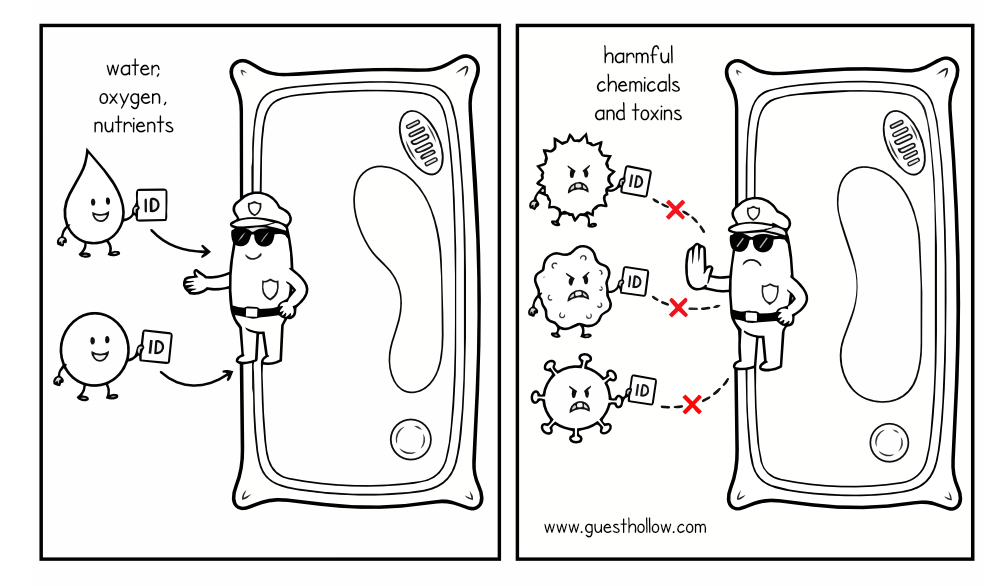
So how does the membrane actually pull this off? It uses several different processes to move things in and out.
One process is diffusion. Diffusion happens when molecules (the tiny building blocks that make up everything around us) move from an area where there are many of them to an area where there are fewer of them. Think about the smell of bacon wafting over from the stove. The scent molecules slowly spread out through the room, filling it with a delicious smell. That’s diffusion!
The other process is active transport. Active transport is when the cell uses energy to move things in or out.
Think of it this way: Imagine you’re leaving a concert, and everyone is naturally flowing toward the exit (that would be like diffusion). But you need to get backstage, so you have to push your way through the crowd in the opposite direction. That takes effort and energy! That’s like active transport.
In cells, special proteins in the membrane act like tiny pumps or revolving doors. They grab specific molecules and actively push or pull them across the membrane, using ATP (the cell’s energy “coins”) as fuel. This lets the cell:
- Pull in nutrients even when there’s already a lot inside (like stocking up on supplies)
- Pump out waste even when there’s more waste outside than inside (like taking out the trash uphill)
Important note about the video below: It only shows items being transported one way through the cell membrane, but active transport actually works both ways – pumping things in AND pumping things out, depending on what the cell needs!
The Cell Wall and Cell Membrane: A Dynamic Duo
Here’s something you need to know: animal cells have cell membranes too, but they’re flying solo. Plant cells? They’ve got both a cell wall AND a cell membrane working as a tag team. It’s like wearing both a leather jacket and a raincoat. Double protection!
But here’s where it gets really interesting. These two structures do completely different jobs, and there’s a brilliant experiment that shows exactly how they work together.
The setup is simple: Take some onion cells and add plain water. Then add salt water. Watch what happens to the cells.
What you’re about to see looks like magic, but it’s actually just incredible cell biology in action. The experiment will show you the difference between the rigid, unchanging cell wall and the flexible, dynamic cell membrane. Pay close attention to what moves and what stays still!
What just happened? Let’s break it down:
Part 1: The Water Flood
Osmosis is the movement of water across a membrane from an area with more water to an area with less water (often toward the side with more dissolved particles).
When plain water hits those onion cells, water molecules rush inside like kids running into a swimming pool. The cell membrane (the inner flexible layer) starts swelling up, filling with water like a balloon being inflated.
Now here’s the critical moment: those cells should explode, right? All that water pressure building up inside should make them burst like overfilled water balloons.
But they don’t!
Why? Because the cell wall (the tough outer layer) is holding everything together like a suit of armor. The membrane can swell and swell, pressing against the wall, but the wall says “Nope, you’re not going anywhere.” It’s like trying to inflate a balloon inside a glass jar. The balloon can only expand so far before the jar stops it.
Part 2: The Salt Water Surprise
Now watch what happens when salt water is added. Suddenly everything reverses!
The water inside the cells starts moving OUT (because water always moves toward higher concentrations of dissolved stuff, and salt water has more dissolved particles than the cell’s interior). The cell membrane starts shrinking, pulling away from the cell wall like a deflating balloon.
But here’s the key observation: the cell wall doesn’t move at all! It stays exactly where it was, rigid and unchanging, while the membrane inside shrivels up.
It’s like watching a water balloon deflate inside a wooden box. The balloon gets smaller, but the box stays the same size.
Why This Matters
This experiment perfectly demonstrates the difference between these two critical structures:
Cell wall = Strong, stiff, unchanging framework (like the frame of a house that never moves)
Cell membrane = Flexible, dynamic barrier that can expand and contract (like a water balloon that changes size)
Together, they give plant cells something animal cells don’t have: the ability to withstand enormous water pressure without exploding. This is one reason plant cells can handle changes in water pressure without bursting. The cell wall acts as a pressure vessel, while the membrane controls what goes in and out.
Pretty clever design for a microscopic structure, right?
The Nucleus: Command Central
Every plant cell has a control center called the nucleus. But here’s what makes it remarkable: inside this tiny round structure is something so valuable, so critical to the plant’s survival, that the cell keeps it locked away like treasure in a vault. That something? DNA.

DNA: The Ultimate Plant Blueprint
If you unraveled all the DNA in just one plant cell and stretched it out, it would be incredibly long. Now imagine that impossibly long instruction manual crammed into a space smaller than the period at the end of this sentence. That’s some serious packaging!
DNA tells plant cells everything: how to grow roots, when to make flowers, what color the petals should be, how to respond to sunlight, even how to defend against insects. It’s like having the world’s most detailed gardening guide, architectural blueprint, and survival manual all rolled into one impossibly long molecule.
But here’s the thing about such a long instruction manual. You can’t just leave it lying around in a tangled mess. The plant would never find the right instructions when it needs them! That’s where genes and chromosomes come in.
Genes: Individual Recipes in the Manual
Think of DNA as one incredibly long string with different sections marked off. Each section is called a gene, and each gene contains the instructions for making one specific protein. It’s like having individual recipes along a really, really long scroll.
Want to make chlorophyll (the green pigment that captures sunlight)? There’s a gene for that. Need a protein to help roots absorb water? Different gene. Building flower petals? Another gene. A plant’s DNA contains thousands of different genes, each one a recipe for a different protein that helps the plant survive and thrive.
Chromosomes: Keeping It All Organized
Now imagine trying to store that incredibly long string of DNA. You can’t just wad it up randomly. Instead, plant cells do something brilliant: they wrap the DNA around special proteins and fold it up into neat, organized packages called chromosomes.
Think of it like this: if DNA is a super long string, chromosomes are that string carefully wound up on spools so it doesn’t tangle, break, or get lost. This packaging keeps everything organized, protects the DNA from damage, and makes it possible for the cell to quickly find the exact gene it needs when the plant needs to respond to its environment.
Let’s take a look at a diagram that shows what we’ve been learning about, so that you can visualize it:

Proteins: The Plant Cell’s Workforce
So DNA contains genes, and genes tell cells how to make proteins. But what are proteins, and why does a plant cell need thousands of different kinds?
Proteins are the workers that do basically everything in a plant cell. They’re made of smaller building blocks called amino acids that link together like beads on a necklace as shown in the picture below:

Once assembled, these proteins become the construction workers that build cell walls, the enzymes that speed up photosynthesis, the transporters that move water and nutrients, the defenders that protect against disease, and so much more!
Without proteins, plant cells would be like a garden with no gardener. Nothing would get done. The plant couldn’t grow, couldn’t make food, couldn’t reproduce, couldn’t survive.
How It All Fits Together
Here’s the big picture: The nucleus stores DNA (the plant’s master instruction manual). DNA is organized into genes (individual recipes). Genes tell the cell how to make specific proteins. Proteins do almost all the actual work in the plant cell.
It’s like having a library (the nucleus) full of gardening books (chromosomes). Each book contains pages (DNA), and on those pages are instructions (genes). Every instruction tells you how to perform a different task (make a protein), and those tasks keep the entire garden (your plant) growing and thriving.
The Nucleolus: A Factory Within a Factory
Inside the nucleus, there’s an even smaller structure called the nucleolus. It looks like a dark spot, and it has one critical job: building ribosomes.

Ribosomes are the tiny machines that actually read the gene instructions and assemble proteins. Plant cells need thousands of ribosomes working constantly to keep up with protein production, especially during rapid growth periods like spring or when a seedling is sprouting. The nucleolus is like a ribosome assembly line, cranking out new ones and shipping them through tiny doorways called nuclear pores into the cytoplasm (the jelly-like stuff filling the cell).
RNA: DNA’s Messenger
Here’s a problem: DNA is too valuable to risk. It never leaves the nucleus. But ribosomes that make proteins are out in the cytoplasm. So how do the instructions get from DNA to the ribosomes?
Enter RNA (ribonucleic acid), DNA’s helper molecule.
Think of it this way: DNA is the original master gardening manual locked in a vault. It’s too precious to take out and risk damaging.
RNA is like a photocopy of individual instructions that can safely travel around the cell.
When a plant cell needs to make a specific protein (maybe to respond to drought, or to start flowering, or to fight off a fungus), it makes an RNA copy of that gene, sends the copy out to the ribosomes, and the ribosomes read the copy to build the protein.
When Plant Cells Kick Into High Gear
Plant cells that are growing fast (like cells in a sprouting seed or a rapidly growing root tip) have bigger, busier nucleoli. It’s like a factory running overtime to meet demand. The cell needs more ribosomes to make more proteins for all that growth, so the nucleolus kicks into high gear, pumping out ribosome parts as fast as it can.
This is happening right now in every growing plant around you, millions of times per second, in every cell. That tiny seedling pushing through the soil? Its nucleoli are working overtime. Pretty amazing for something you can’t even see without a microscope!
Ribosomes: Tiny Protein Factories Working Overtime
Remember those ribosomes that get assembled in the nucleolus? Time to see what makes them so important!
Ribosomes are incredibly small. If a plant cell were the size of a basketball, a single ribosome would be smaller than a grain of sand. They don’t even have a protective membrane like other organelles. They’re just little clusters of RNA and proteins, either floating freely in the cytoplasm or stuck to another organelle called the endoplasmic reticulum (we’ll get to that soon).
But here’s the thing: without ribosomes, cells couldn’t make proteins. And without proteins? Life doesn’t exist!
Building Proteins Like LEGO Instructions
Imagine you’re building with LEGOs. You have a huge bin of different colored bricks (those are amino acids), and you have an instruction booklet that shows you exactly which brick to snap on next. That instruction booklet is a molecule called mRNA, short for “messenger RNA.” It’s basically a copy of the instructions from the DNA in the nucleus, carried out to the ribosome so the cell knows what to build.
The ribosome is like your hands following those instructions. It grabs the right amino acid brick, snaps it onto the growing chain, then grabs the next one, and the next one, building the protein piece by piece in the exact right order.
Get one brick wrong? The whole protein might not work. It’s like building a LEGO car but accidentally putting a wheel where the steering wheel should go. The ribosome has to be perfect every single time.
This process of reading the RNA instructions and building the protein is called translation.
You can see it happen in the following video. The video is showing the process in a human cell, but it works the same in a plant cell:
Why Plant Cells Need Thousands of Ribosomes
Picture a busy factory with thousands of workers on different assembly lines, all building different products at the same time. That’s what’s happening in a plant cell. A single cell might have 10,000 ribosomes all working simultaneously!
Why so many? Because plants need massive amounts of proteins:
- Enzymes (special proteins that speed up chemical reactions, like helpers that make things happen faster) for photosynthesis so the plant can make food from sunlight
- Structural proteins that build and repair those tough cell walls, kind of like construction workers
- Transport proteins that move water and nutrients around the cell, like delivery trucks
- Defense proteins that protect the plant from diseases and hungry insects trying to eat it
When a seed sprouts and starts growing, it needs proteins even faster. The cell cranks out more ribosomes to keep up with demand, like a factory hiring more workers during the busy season.
Chloroplasts: The Ultimate Solar Panels
Here’s something wild: right now, the plant on your windowsill is doing something no human technology can match. It’s capturing invisible light particles from the sun and turning them into food. Not just any food, but the exact kind of sugar (glucose) that powers nearly every living thing on Earth.
That’s photosynthesis, and it happens inside chloroplasts.
Chloroplasts are the reason plants are green. They’re packed with a green pigment called chlorophyll that’s really good at one thing: grabbing sunlight. But chlorophyll is picky. It absorbs red and blue light but reflects green light back at your eyes. That’s why leaves look green!
The Most Important Chemical Reaction on Earth
Inside each chloroplast, something remarkable is happening. The chloroplast takes three simple ingredients (sunlight, water, and carbon dioxide from the air) and combines them to make glucose (sugar) and oxygen.
Think about that for a second. Plants are literally making food out of thin air and sunlight. If humans could do this, we’d never need grocery stores. We’d just stand outside on a sunny day and make lunch!
Note: Some of you may be thinking right now: Wait? But what about the minerals and stuff a plant gets from the ground? Isn’t that part of the plant’s food?
Great thinking! Here’s the difference. Minerals from the soil are more like vitamins than food. Think about it this way: you could swallow a whole bottle of vitamins and you’d still be starving. Vitamins help your body work, but they don’t fill you up or give you the energy to run around. You still need actual food for that. Plants are the same way. The glucose they make through photosynthesis is their actual food, the stuff that gives them energy to grow, bloom, and make seeds. The minerals they pull from the soil are helpful extras, but you can’t run a plant on minerals alone any more than you can run yourself on vitamins alone. We’ll talk about this more later in the chapter about photosynthesis.
Back to chloroplasts: That oxygen plants release as a “waste product”? That’s the oxygen you’re breathing right now. Nearly every breath you take came from a chloroplast somewhere on Earth, either in a plant or in algae floating in the ocean.
No chloroplasts = no oxygen = no you. It’s that simple.
Stacks of Green Pancakes
Inside each chloroplast are stacks of flat, disc-shaped structures called thylakoids. If you could shrink down and look at them up close, they’d look like stacks of green pancakes piled on top of each other.
These thylakoid stacks are where the magic happens. This is where sunlight gets converted into chemical energy that the plant can actually use. It’s like a solar panel, except way more efficient than anything humans have invented. Scientists have been trying to copy this process in labs for decades, and we still can’t match what a simple leaf does effortlessly every single day.
Here is a 3D model of a chloroplast for you to explore. Notice the thylakoids that look like stacks of green pancakes!
3D model by jlf_illustration at Sketchfab.
Mitochondria: The Cell’s 24/7 Power Grid
Here’s a problem: chloroplasts are amazing at capturing sunlight and making glucose (sugar), but here’s the catch. That glucose is like having a hundred-dollar bill when you need to buy something from a vending machine that only takes quarters. The energy is there, but it’s in the wrong form for the cell to actually use.
Enter mitochondria, the cell’s energy conversion specialists.
From Food to Fuel
Think of it this way: chloroplasts are the kitchen that cooks the meal. Mitochondria are the digestive system that breaks that meal down into energy the cell can actually use to do work.
Mitochondria take the glucose made by chloroplasts and convert it into ATP (adenosine triphosphate), which is basically the cell’s energy currency (think how you can use coins to pay for something, but ATP is also like little batteries which I’ll explain in a bit). ATP is like those quarters for a vending machine, except instead of buying snacks, cells use ATP to pay for everything cells do: growing, moving materials around, building new structures, repairing damage, fighting off diseases, you name it.
Here’s the brilliant part: mitochondria are like ATMs scattered throughout the cell. Whenever a part of the cell needs energy, it doesn’t have to travel all the way back to the chloroplast. It just grabs some ATP “coins” from the nearest mitochondrion and gets to work.

How Mitochondria Make ATP
The process is called cellular respiration, and it’s kind of like controlled burning. Mitochondria take glucose molecules (remember, those were made in the chloroplasts) and break them apart, combining them with oxygen. When those bonds break, energy is released, similar to how burning wood releases heat.
But here’s where mitochondria are clever: instead of letting all that energy escape as heat, they capture it and store it inside ATP molecules. It’s like taking the energy from a campfire and somehow bottling it up into tiny rechargeable batteries that you can use later.
Every time a cell needs to do work, it “spends” an ATP molecule. The ATP breaks apart, releases its stored energy to power whatever job needs doing, and then gets recharged by the mitochondria. It’s a constant cycle of spending and recharging, happening millions of times per second in every cell.
Working Around the Clock
Here’s something important: mitochondria work 24/7, even when it’s pitch-black outside and the chloroplasts have shut down for the night. Plants still need energy at night to grow, repair damage, transport water, and stay alive. That’s when mitochondria really prove their worth, running on the glucose reserves the chloroplasts made during the day.
Think about a sprouting seed underground. It has no access to sunlight, so its chloroplasts can’t function yet. But its mitochondria are working overtime, breaking down the stored food in the seed to power the growth of roots and shoots. Without mitochondria, that seed would never make it to the surface.
More Work = More Mitochondria
Cells that work harder are packed with more mitochondria. Root tip cells that are constantly growing and pushing through soil? Loaded with mitochondria. Leaf cells that are actively running photosynthesis and making sugars? They need tons of mitochondria to power all that chemical work.
It’s like a factory. A small operation might have one generator. A massive factory running three shifts needs multiple backup generators running constantly. It’s the same principle.
A Unique Feature
Here’s something interesting: mitochondria have their own DNA, completely separate from the DNA in the nucleus. This is one of the unique features that makes mitochondria different from other organelles in the cell.
The Bottom Line
The setup is simple. Chloroplasts catch the sunlight and make glucose. Mitochondria take that glucose and turn it into ATP the cell can actually spend. One makes the fuel, the other makes it usable.
Without mitochondria, plants couldn’t grow in the dark, seeds couldn’t sprout underground, and roots couldn’t push through soil. The glucose made by chloroplasts would just sit there, useless, like having money you can’t spend.
Right now, in every plant around you, billions of mitochondria are breaking down glucose and pumping out ATP, keeping those plants alive and growing. They’ve been doing it nonstop since the moment the seed sprouted, and they won’t stop until the plant dies.
Vacuoles: Storage Warehouses and Waste Management
Pop quiz: What takes up 90% of a plant cell’s interior space but gets almost no credit for keeping the plant alive?
The central vacuole. And it’s about time this underappreciated organelle got some respect!

Imagine if 90% of your house was just one giant room. Not your bedroom, not the kitchen, not the living room. Just one massive storage tank that also happened to be your water supply, your pantry, your recycling center, AND your structural support system all rolled into one.
That’s basically what the central vacuole is doing in a plant cell.
The Water Pressure Trick
Here’s where vacuoles pull off something that seems impossible: they keep plants standing upright without any bones, muscles, or skeleton whatsoever.
The secret? Turgor pressure.
Turgor comes from the Latin word turgor meaning swelling or inflation.
Turgor pressure describes the firmness or swelling of plant cells caused by water pushing against the cell wall.
Think of it like this: Take a cardboard tube (that’s the cell wall). Now blow up a balloon inside it (that’s the vacuole filling with water). The balloon pushes outward against the cardboard walls, making the whole structure rigid and sturdy. That outward pushing force? That’s turgor pressure!
Now multiply that by millions of cells, all pushing outward at the same time, and suddenly you can build a sunflower that stands six feet tall or a tree that reaches hundreds of feet into the sky. No bones required!
The Wilting Plant Mystery: SOLVED
Ever wondered why a thirsty plant droops over like it’s given up on life? Now you know the answer!
When a plant runs out of water, the vacuoles shrink. No water = no outward pressure = no structural support. The cells go limp, and the whole plant collapses like a deflated balloon. It’s not dying (yet). It’s just lost its internal water pressure.
- But give that sad, droopy plant a drink, and within hours, the vacuoles refill with water. Turgor pressure returns. The cells firm up. The plant stands tall again, like nothing ever happened!
It’s like watching a time-lapse resurrection. The plant literally inflates itself back to life using nothing but water pressure. Try doing that with your skeleton!
But Wait, There’s More!
The vacuole isn’t just a water tank. It’s a multi-tasking champion that is also:
- A storage pantry: Nutrients, sugars, proteins, whatever the cell might need later get stashed in the vacuole like a microscopic warehouse.
- Waste management: Toxic substances and cellular garbage get isolated in smaller vacuoles, quarantined away from the rest of the cell like hazardous waste in sealed containers.
Definition: Toxins are poisons that can hurt cells or living things.
- A color factory: Those vibrant reds, purples, and blues in flower petals? They come from pigments called anthocyanins that the cell builds in its cytoplasm from sugars and other simple molecules. Once the pigments are assembled, the cell ships them into the vacuole for storage, kind of like mixing paint and then pouring it into a bucket. Here’s a fun detail: the pH inside the vacuole actually affects the final color. More acidic? The pigment looks red. Less acidic? It shifts toward blue. Same pigment, different color, all because of the chemistry inside the vacuole. Roses, morning glories, violets, and petunias are all showing off their vacuole collections.

- Chemical warfare headquarters: Some plants store nasty-tasting or poisonous compounds in their vacuoles to discourage animals from eating them. Bite into the wrong plant, and you’re tasting vacuole defense chemicals!
Without vacuoles, plants would be floppy puddles of cytoplasm that couldn’t stand up, couldn’t store water, couldn’t protect themselves from toxins, and would be completely colorless.
Every time you see a plant standing tall, every time you admire a colorful flower, every time you watch a wilted plant perk back up after watering, you’re witnessing the power of vacuoles doing their job.
Endoplasmic Reticulum and Golgi Apparatus: The Assembly Line and Shipping Center
If the nucleus is the cell’s command center and mitochondria are the power plants, then the endoplasmic reticulum (ER) and Golgi apparatus are the manufacturing and shipping departments working overtime to keep everything running.
But here’s what makes this duo fascinating: they’re basically running a 24/7 factory inside a space smaller than the period at the end of this sentence.

The Endoplasmic Reticulum: Two Factories in One
The ER is like a massive network of folded membranes snaking through the cell. If you could unfold it and lay it flat, it would cover an area way bigger than the entire cell! It comes in two varieties, and they do completely different jobs:
Rough ER gets its name because it’s absolutely covered in ribosomes, making it look bumpy under a microscope (like sandpaper versus smooth paper). Those ribosomes are churning out proteins nonstop. Remember, proteins are the workers that do basically everything in the cell, so the rough ER is like a protein factory running three shifts a day, every day, forever.
Smooth ER has no ribosomes, so it looks, well, smooth. But don’t let the clean appearance fool you. This is where the cell manufactures lipids (fats and fat-like molecules that make up cell membranes and store energy). The smooth ER also runs the cell’s detox center, breaking down harmful substances before they can cause damage.
Wait, Lipids Store Energy? What About ATP?
Good question! Here’s the difference, and it’s actually pretty clever:
ATP is like a rechargeable AA battery. It provides quick bursts of energy right now for immediate work like moving materials, building proteins, or pumping ions across membranes. Fast energy, but it doesn’t last long.
Lipids are like a fuel tank or a pantry full of food. They store massive amounts of energy for later use when the cell needs a bigger supply or when food isn’t available. Long-term storage, ready when needed.
Think of it this way: ATP is your lunch money for today. Lipids are your savings account for emergencies. The cell needs both!
The Golgi Apparatus: The Packaging and Shipping Expert
Once the ER finishes making proteins and lipids, they need to get where they’re going. That’s where the Golgi apparatus steps in, and it’s basically the cell’s version of Amazon’s fulfillment center.
Here’s how it works:
Step 1: Receiving – Proteins and lipids arrive from the ER in tiny membrane bubbles (like packages wrapped in bubble wrap).
Step 2: Modification – The Golgi adds finishing touches, like molecular address labels and special chemical tags that say “Deliver to cell membrane” or “Ship outside the cell” or “Store in vacuole”.
Step 3: Sorting – Different products get sorted into different shipping lanes based on their destination.
Step 4: Packaging – Everything gets repackaged into new membrane bubbles, sealed up tight, and sent on its way.
Step 5: Delivery – Those bubbles travel to their destinations and deliver their cargo.
It’s like a microscopic post office that never closes, processing thousands of packages per second!
Why This Matters
Without the ER and Golgi working together, the cell would be chaos. Proteins would be made but never delivered. Lipids would pile up with nowhere to go. Cell membranes couldn’t be repaired. Waste products couldn’t be packaged for removal.
These two organelles are the reason plant cells can:
- Build and repair their cell membranes
- Manufacture the oils and waxes that coat leaves (keeping them from drying out)
- Produce and package enzymes for photosynthesis
- Create the proteins needed for growth
- Detoxify harmful chemicals before they cause damage
All of this is happening as you read. Inside every nearby plant cell, the ER is cranking out proteins and lipids while the Golgi sorts, labels, and ships each one to the right address. It’s a delivery operation smaller than a speck of dust, and it never clocks out.
Let’s watch a video that zooms down into a leaf. See if you recognize any of the parts we just learned!
Plant vs. Animal Cells
You’ve spent this whole chapter exploring plant cells. Now it’s time for the big question: How are plant cells different from animal cells, and why does it matter?
Here’s the short answer: They’re built from the same basic kit, but each one carries different gear that fits the very different way it lives.
Think of it this way: A deep-sea submarine and a fighter jet are both vehicles, both have engines and control systems, but they’re built for completely different purposes. Same deal with plant and animal cells.
DIFFERENCE #1: The Cell Wall (Plant Armor)
The Problem: Plants can’t move.
Think about that for a second. When danger comes, animals run. When food runs out, animals migrate. When the weather turns bad, animals seek shelter.
Plants? They’re stuck. Rooted in one spot for their entire lives. They can’t escape hungry insects, can’t run from storms, can’t dodge strong winds. They need serious protection and support, and they need it built into every single cell.
The Solution: The cell wall.
This rigid outer layer made of cellulose acts like a suit of armor around every plant cell. It’s what allows plants to stand upright and grow tall without having bones. Imagine trying to build a 300-foot redwood tree out of water balloons. Impossible, right? But wrap each balloon in a tough shell, stack millions of them together, and suddenly you can build a skyscraper.
But here’s the catch: That same rigid wall that gives plants strength would be a disaster for animals.
Imagine trying to do jumping jacks while wearing a stiff cardboard box from head to toe. Pretty hard, right? That’s what it would be like for animal cells if they had rigid cell walls. You couldn’t flex your arm (muscle cells need to slide past each other). Your white blood cells couldn’t stretch around bacteria to swallow them up (a process called phagocytosis). Your heart couldn’t beat (cardiac cells need to contract and relax).
Animal cells solve the support problem differently: They have skeletons (either internal like ours or external like insects). This lets individual cells stay flexible while the whole organism gets structural support.
Between animal cells, there’s a network of proteins called the extracellular matrix that acts like scaffolding, holding tissues together without restricting movement. Think of it like the difference between a brick wall (rigid, can’t move) and a chain-link fence (provides structure but stays flexible).
Bottom line: Plant cells need rigid walls to stand upright without skeletons. Animal cells need flexibility to move, grow, and respond quickly. Each is perfectly designed for its lifestyle!


DIFFERENCE #2: Chloroplasts (The Solar Panel Difference)
The Problem: Plants can’t hunt for food.
Animals can move around searching for their next meal. Plants are stuck in one spot. So how do they get energy?
The Solution: They make their own food from sunlight!
Chloroplasts are the organelles that capture light energy and convert it into sugar through photosynthesis (we’ll dive deep into this process in Chapter 9). It’s like having built-in solar panels that turn sunshine into lunch.

Important note: Not all plant cells have chloroplasts! Only the parts of plants that are exposed to light and perform photosynthesis contain chloroplasts. Leaf cells? Packed with them. Green stem cells? Yep. But root cells deep underground? Nope. The white flesh of an onion bulb? No chloroplasts there either (remember those onion cells we looked at earlier? They were clear, not green!). Flower petals, seeds, and many internal stem cells also lack chloroplasts. So when we say ‘plant cells have chloroplasts,’ we really mean ‘photosynthetic plant cells have chloroplasts.
Animals don’t have chloroplasts. Instead, they have to eat plants or other animals to get energy. Both plant and animal cells have mitochondria to release energy from food, but only plant cells can make that food in the first place.
This difference shapes everything:
Plants: Grow toward light, spread out leaves to capture maximum energy, stay in one place soaking up sun
Animals: Move, hunt, graze, forage, requiring completely different cell structures and abilities
A crazy exception: A few species of sea slugs can actually steal chloroplasts from the algae they eat and use them temporarily to capture energy from sunlight! They can live off sunlight for up to a year before needing to eat more algae. It’s like a solar-powered animal. Check out the video below!
DIFFERENCE #3: The Central Vacuole (Water Tank and Structural Support)
The Problem: Plants can’t drink water whenever they want.
You get thirsty? You grab a glass of water. A deer gets thirsty? It walks to a stream. Plants? They’re stuck waiting for rain or relying on whatever water their roots can find underground.
The Solution: Store massive amounts of water in a giant central vacuole.
As you learned earlier, plant cells have a central vacuole that can take up 80-90% of the cell’s volume. That’s like having a water tank that fills up your entire basement, attic, and most of your living space!
But the vacuole does more than just store water. When it’s full, it pushes outward against the cell wall, creating turgor pressure that keeps the plant standing upright. It’s like an inflatable support beam. No water? The plant wilts and droops. Add water? The vacuoles refill and the plant stands tall again within hours!
Animal cells don’t need giant vacuoles because:
- Animals drink water regularly (no need for massive storage)
- Animals have skeletons for support (don’t need water pressure to stand up)
- Animal cells need space for organelles that support movement and quick responses
Some specialized animal cells (like certain white blood cells) form temporary food vacuoles when they engulf bacteria, but that’s completely different from the permanent, massive central vacuole in plant cells.
WHAT’S THE SAME: The Shared Toolkit
Despite these major differences, plant and animal cells share the same basic operating system! Both have:
- A nucleus: The command center that stores DNA and controls all cell activities. Whether you’re a rose or a rabbit, you need instructions!
- Mitochondria: The power plants that convert food into ATP energy. Even plants that make their own food still need mitochondria to unlock that energy.
- Ribosomes: The protein factories. All living cells need to make proteins, so all living cells have ribosomes.
- An endoplasmic reticulum and Golgi Apparatus: The manufacturing and shipping departments that build, modify, package, and transport proteins and lipids throughout the cell.
- A cell membrane: The flexible barrier that controls what enters and exits the cell. Even plant cells have this membrane located just inside the cell wall, as you saw in the onion cell video.
- Cytoplasm: The jelly-like substance that holds organelles in place and allows chemical reactions to occur.
The Big Picture
So what’s the takeaway? Living things run on the same basic blueprint, then get kitted out with different equipment depending on how they live.
Plant cells are built to stay put and run on sunlight. Animal cells are built to move and react fast. Neither is better. They’re just good at different jobs.
Don’t worry if you can’t remember all of these details! If you study biology, you will likely visit these topics again! For now, just remember the big three differences:
- Plant cells have large central vacuoles (for water storage and structural support)
- Plant cells have rigid cell walls (for support without skeletons)
- Photosynthetic plant cells have chloroplasts (to make food from sunlight)
Here’s a video that wraps up what you’ve just read:
What do you think was the hardest to learn? What do you think was the easiest? Feel free to share in the comments below! 😊